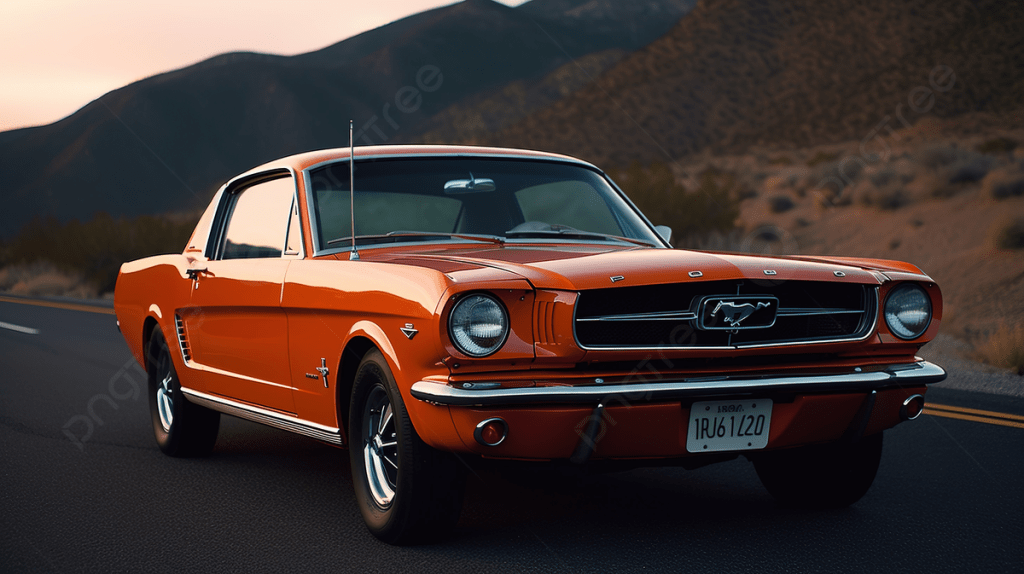
Just saying those two magical words evokes memories for millions of kids and adults alike.
When a car is created in just such a way, that’s the power it has.
The Ford Mustang has it in spades. And it’s had it for 60 years.
A Small Car
The ’60s saw the gradual decline of the outlandish concepts that were being created by US automakers, particularly the “Big Three”. Gone were the jet-age themed Golden Rockets, Firebirds and Club de Mars as North American OEMs reined in the wild spending.
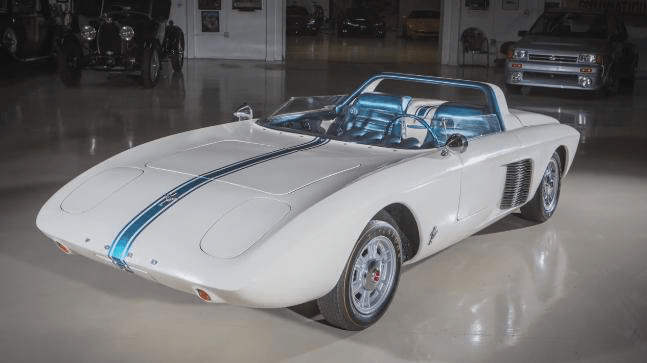
They didn’t halt their creativity completely, mind, and Ford’s Mustang I concept of 1962 is a great example of a focused concept that demonstrated both realistic themes and wild ideas simultaneously.
And it was this concept that birthed the production Mustang, though you’ll have to squint really hard to find the similarities. In fact, whilst it’s the wonderfully proportioned roll hoop and side intakes that draws my attention, for Lee Iacocca and the Ford higher-ups, the vehicle’s proportions were less a distraction and more a distinction.
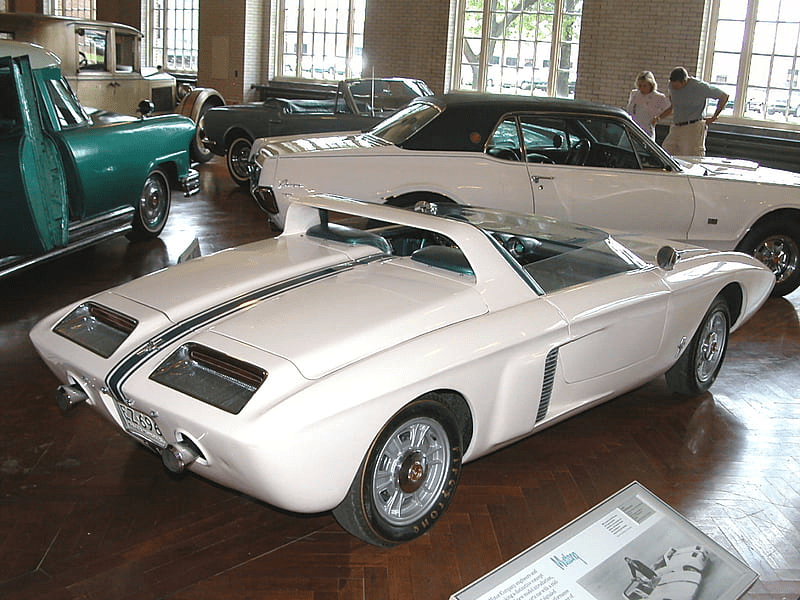
Following the Mustang I’s successful debut at the United States Grand Prix in Watkins Glen, New York on October 7, 1962, whereupon it was actually driven around the track, Iacocca turned to his design teams and challenged them to propose designs for a “small car“, inspired by the concept.
Whilst not a lot to go on initially, this was quickly turned into five distinct requirements that, according to Jalopnik, would create a car that:
- would seat four;
- had bucket seats and a floor mounted shifter;
- weighed no more than 2,500 pounds (1,100 kg) and be no more than 180 inches (5 m) in length;
- would sell for less than US$2,500(equivalent to $24,560 in 2023);
- would have multiple power, comfort, and luxury options.
Easy peasy.
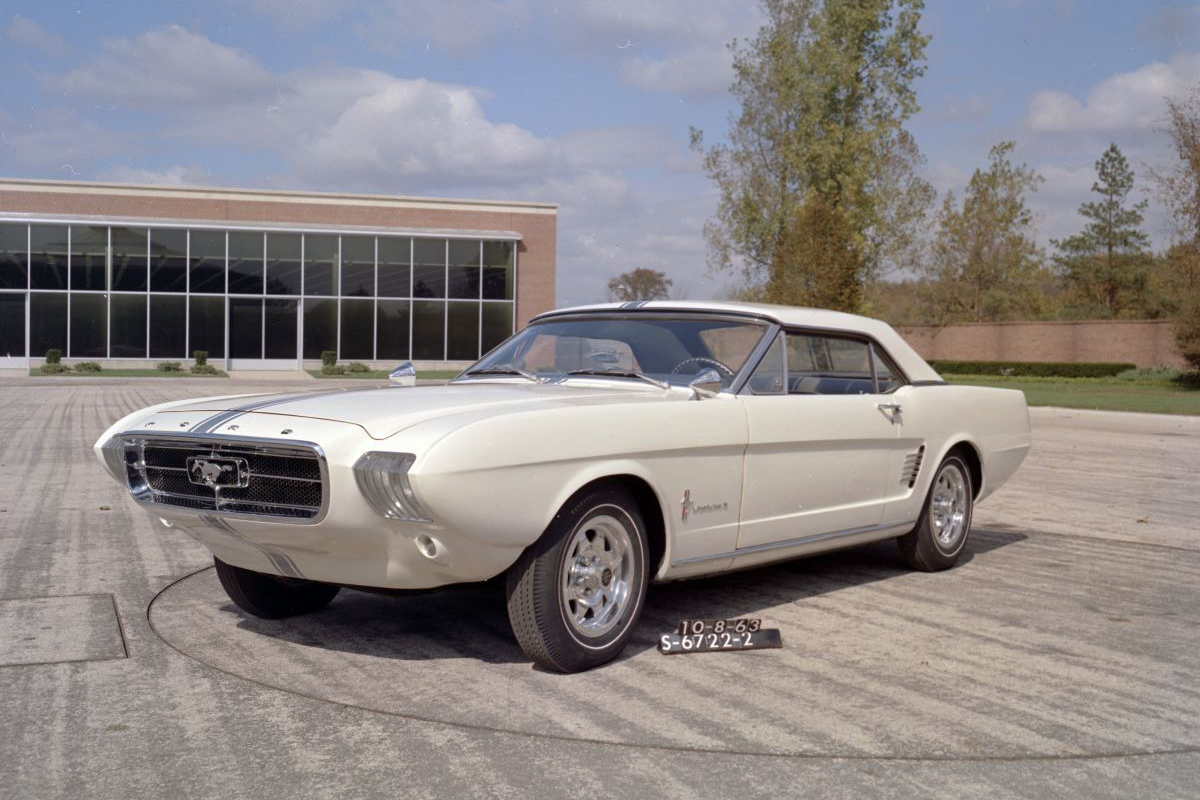
These requirements were then passed on to Ford’s three design studios at the time (Advanced Design, Lincoln-Mercury and Ford) and the winner would see their design put into production. So the stakes were high.
Whilst I continue trying to guarantee the authenticity of what is a heap of black and white images online all pertaining to be Ford Mustang concepts from between 1962 & ’63, what’s clear is that Ford’s own design studio won, their “Cougar” concept (above) laying the foundations for what was to come.
Whilst many people pertain to have designed the whole thing, the consensus is that several people, a team if you will, including Joe Oros, L. David Ash, Gale Halderman, John Foster, and George Schumaker all contributed to the idea spawned by Lee Iacocca.

(such as this one on Classic Auto Mall)
Must-Have-Ang
With Ford keen to limit outlandish development costs, the chassis, suspension and drivetrain (the V6 anyway) were all taken from the Falcon (above), but of course the body, plus wheelbase and track, were all unique.
With several tweaks made to the concept, particularly roof height for cabin space and the front end, the Mustang was ready for launch by the end of March 1964, an odd time to launch a car. You’ll find most cars are officially launched in the final 3-4 months of the year, with an official production date of the proceeding year.
But the Mustang did it’s own thing, including several durability problems which forced Ford, much like several other more modern vehicles like the Jaguar F-Type, to launch the Convertible variant ahead of the hard top.

The very first Mustang was sold on the 14th April 1964, with a debut at the World’s fair following three days later. On just its first day at the fair, 22,000 deposits were taken by Ford. They were on to something.
That something was a front-wheel drive, four seater with both I6 and V8 offerings, manual transmission and sensible upholstery with costly options… if you wanted. If not, you were looking at a starting price of US$2,368, or US$23,263 at 2023 rates. Incomparable.
Though Plymouth had, just weeks before, released their Barracuda, Ford’s combination of reputation and sales network, plus the Mustang’s charm, beauty and, perhaps most importantly, a V8 offering, caused quite a stir.

Within 6 months, the I6 engine capability grew from 105bhp to 120bhp and the V8 offerings grew far beyond 200hp, whilst the lineup was expanded to include both hard-top and GT variants, the latter with grille-mounted fog lamps, rocker-panel stripes, and disc brakes, plus the 225hp V8 powerplant.
The options list remained extensive, with items such as adjustable driver and passenger bucket seats, an AM radio, a floor-mounted shifter, sun visors, a (mechanical) remote-operated mirror, a floor console, a bench seat and under-dash air conditioning all available for purchase.
They were selling like hotcakes, having no direct competitor but the Barracuda, and with each model year came an evolution, all with the aim of keeping the Mustang fresh.

Shelby
The GT variant also saw the introduction of the iconic Shelby name onto a fastback-bodied Mustang that would go on to be incredibly sought-after. These GT350 models were stunning, and were the lightest of any Mustang made, with Shelby America overseeing introducing several changes before releasing to dealers.
There was the introduction of a new carburettor to the 4.7L V8 engine to push performance beyond 206bhp (310 PS; 228 kW); there was a 4-speed manual transmission and 9-inch live rear axle; and there was the replacement of both front and rear brakes.
There was even 34 GT350R variants built for SCAA competitions, and these proved highly successful on the track.
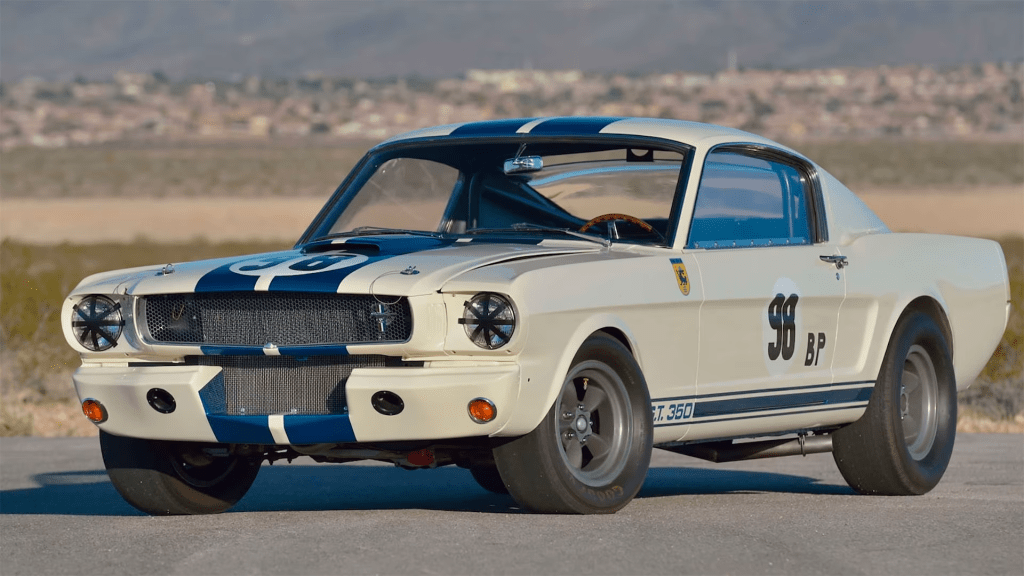
So successful was this partnership on the ’65 Mustang that the two companies expanded their offerings for the ’66 variant, with an increased options list, paint colours and even the removal of the Mustang name.
It was marketed simply as the Shelby GT350.
Sadly, 1969 saw the end of the partnership with Carroll Shelby terminating his partnership with Ford. Whether to focus on his own projects, or some disagreement, it’s not clear.
What is that the partnership, in just a few short years, was successful for both parties, with almost 14,000 cars built and delivered, every one of them incredibly desirable thanks to the significance of Shelby’s name.
Evolution
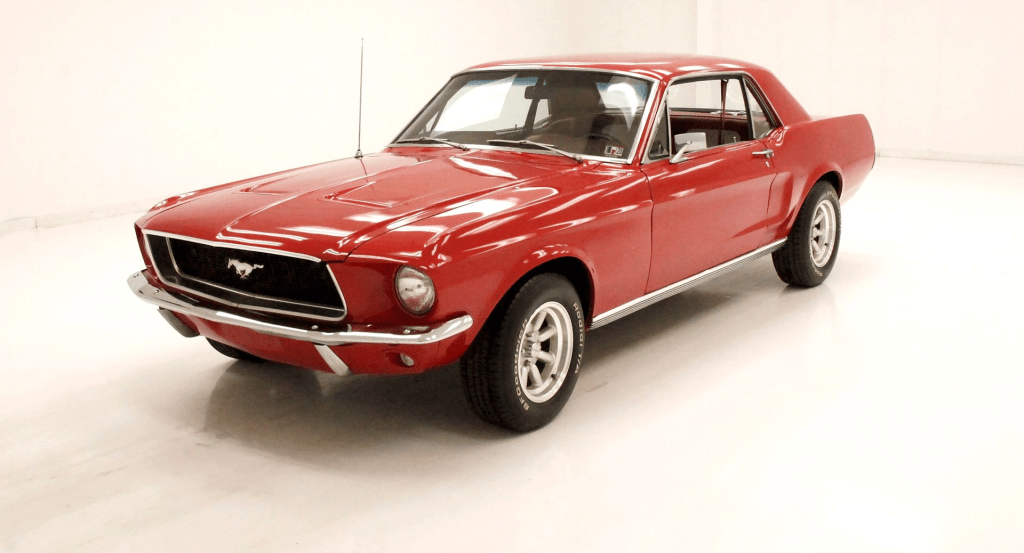
One of the biggest complaints people had with the base Mustangs, especially passengers, was the lack of legroom, but Iacocca wanted the Mustang to remain a small car; that was, after all, the entire premise.
But ’67 saw the first compromise, with a revised – and enlarged – Mustang released to widespread adoration. It was the first Mustang to feature a big-block V8, whilst both the interior and trunk were also increased.
Horsepower continued to increase too, whilst exterior changes gave the Mustang a more aggressive stance, particularly the concave lights, side scoop and tweaked front grille.

There were deluxe interior packages, a host of new options and of course a raft of new engine variants, all to compete in what was soon to be a huge new market. One that Mustang had created, or at least dominated.
The Pony Car.
Because 1967 saw GM release both the Chevrolet Camaro and the Pontiac Firebird, AMC release the Javelin whilst just two years later, on the Plymouth Barracuda platform, Dodge would join the fun with its Challenger. Ford had even dared to compete (sort of) with the Mercury Cougar.

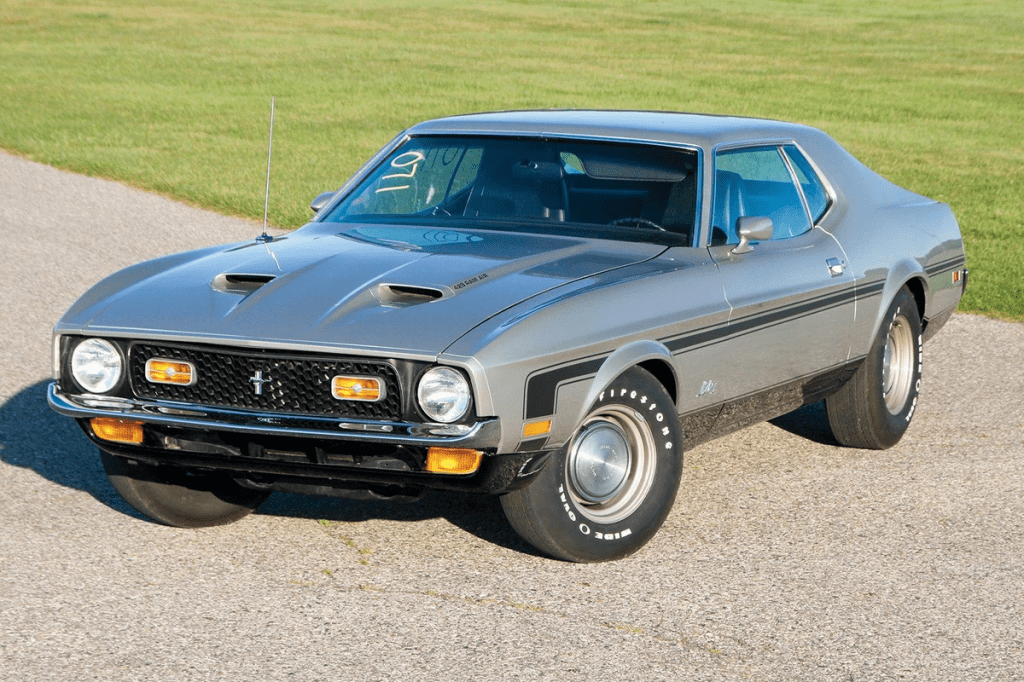
The vehicle continued to grow in every way, with the 1969 offering bringing aggressive rear haunches, an extended front brow and a whole new assortment of features. In addition, three highly-desired options packages, the Mach 1, the Boss 302 and the Boss 429, were added to the lineup.
The Mach 1 proved incredibly popular, with 72,458 units sold in 1969 alone, thanks to its combination of luxury interior (high-backed seats, extra sound deadening, remote sports mirrors and plush fabrics) plus the obvious exterior changes.
But its the far less common Boss variants, particularly the Boss 429, that warrants at least a little attention.

The Boss 302 was created to satisfy Trans Am rules, and used a 302 cu in (4.9 L) H.O. V8 that was developed to meet homologation requirements to compete in Trans Am racing.
Ford’s response to the Chevrolet Camaro Z/28 success in the 5L and under series, the powerplant required all manner of changes for racing, but as a street-legal offering was more than potent and seriously popular.
Despite the 302s potency, it was still a small-block V8, but that could not be said for what lay under the hood of the outrageous Boss 429. This variant was created to homologate the Boss 429 engine for NASCAR racing…!
A 7.0L V8, the engine produced 375 bhp (380 PS; 280 kW) and 450 lb⋅ft (610 N⋅m) of torque at 3400 rpm.
A total of 1,628 Boss 302s and 859 Boss 429s were sold through 1969, making these vehicles somewhat rare.
Final Hurrah
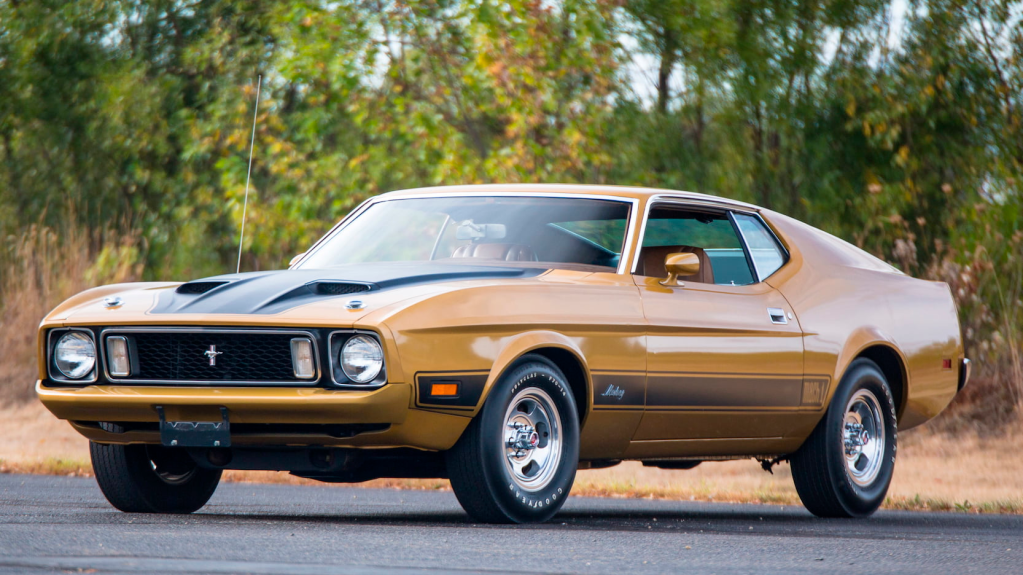
1971 saw the Mustang grow again, specifically to support the Boss 429 engine as a standard offering whilst avoiding expensive suspension updates.
There were still 3 body styles – the hardtop, fastback (SportsRoof as they called it) and convertible – all manner of options and several trim options to tickle your fancy.
At this point, though, there was an argument to be had that the Mustang had wandered away from its founding principles; at 189.5 in (4,813 mm) in length, it was now 74.1 in (1,882 mm) wide and tipped the scales at 3,560 lb (1,615 kg).
It was 8 in (200mm) longer, 6in (150mm) wider and a full 1,115lb (506kg) heavier than the original!
In 1972, U.S. emissions regulations forced a reduction in engine capacity, meaning Ford, and of course other automakers, had to drop several of their highest-powered variants.
They continued tweaking things both inside and out, but the final model year of the original, pony car Mustang, was 1973, with the Mark II that followed a wholly differently vehicle.
But don’t let that tarnish what the Mustang was (or is).
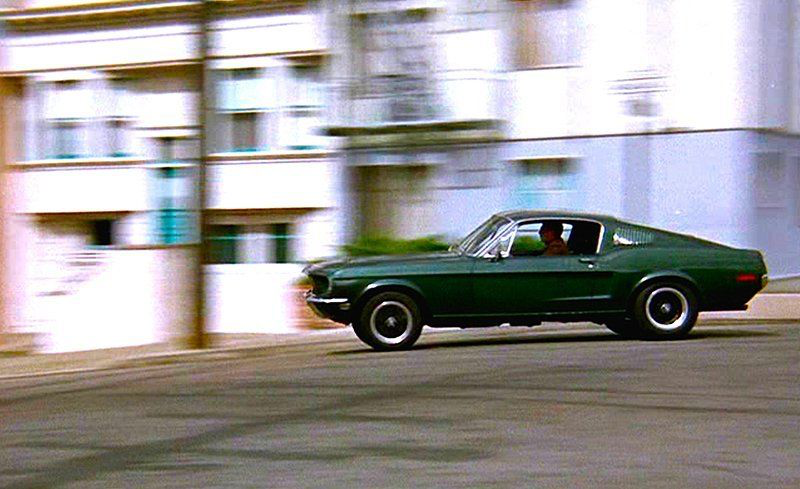
Yes, the Ford Mustang is an ever-present in popular culture, including as both John Wick and Steve McQueen’s ride of choice, but for many people, admittedly of a slightly older generation, the Mustang is so much more.
In the first 2 years of production, 3 factories churned out 1.3 million Ford Mustangs! By the end of its first cycle, in 1973, almost 3 million had been sold, across the globe.
And the name, and model itself, still exists today, and has evolved continuously for 60 years unlike any of its competitors.

Despite the relative economic stability of the ’60s, for many people a car, let alone a performance car such as the Mustang, was an unaffordable luxury. Lee Iacocca and his team provided a dream, neigh (sorry), an opportunity to afford luxury, to own something that was fun, elegant, powerful; that made you feel special. Yet could still take you and the kids on holiday.
How many cars can you think of that do that today?
Happy Birthday, Mustang. And thank you.
***
I can honestly say that having the opportunity to write about cars as special and as iconic as the Mustang is a pleasure.
But to enable us to keep doing so, we need your help. So please, if you want to keep reading our articles and supporting what we do here at CLT, please add your email below to avoid missing out on all that we have to offer in the future 🙂

 Cars Less Traveled
Leave a comment